
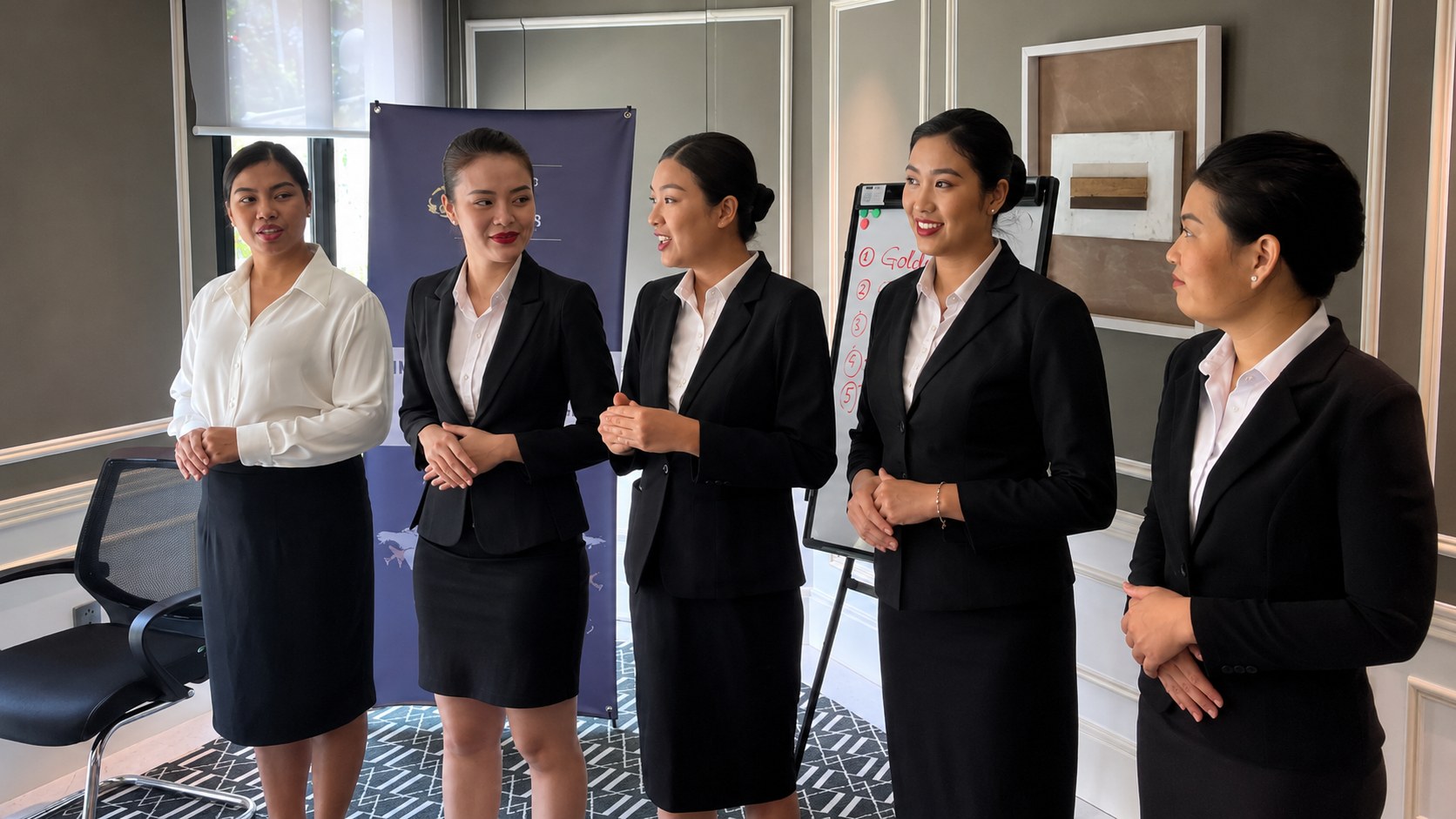
Every airline has its own recruitment process. But the types of questions stay surprisingly similar across most multinational airlines, whether you're answering on a video call or standing in an assessment room. Understanding what each question is designed to assess matters far more than memorising answers.
Note
Traditionally, most airlines recruited primarily from their own nationality. Multinational airlines are different — they recruit cabin crew across many nationalities. Within this group, there are two broad categories:
Highly multicultural airlines (e.g. Emirates, Qatar Airways, Etihad Airways, Riyadh Air), which recruit globally from the outset.
Asia-focused multinational airlines (e.g. Cathay Pacific, EVA Air, StarLux Airlines, Singapore Airlines, ANA), which also recruit internationally but have traditionally drawn most cabin crew from a smaller group of Asian countries.
Budget and low-cost carriers may assess these areas differently or place different emphasis on each stage.
This structure is confirmed directly on Etihad's careers page, and consistently reported at other multicultural carriers.
Introduction / Self-Presentation
This is often the first filter, and it removes more candidates than many people realise — sometimes before any live interview even begins, through the online application and shortlisting process.
A typical opening question is:
"Tell me about yourself."
A weak answer sounds like this:
"My name is X. I'm from Vietnam. I speak English and Vietnamese. I have two years of customer service experience."
Everything is factually correct. Unfortunately, nothing is memorable. Recruiters hear dozens of introductions like this every day.
A stronger introduction uses the same facts but begins with something real:
"I started working in retail because I enjoyed solving a stranger's problem in under two minutes. That's what made me realise I wanted to do the same thing at 35,000 feet."
The experience hasn't changed. The person has.
Most candidates think this stage is simply introducing themselves. It isn't. The recruiter is deciding whether they can already picture working with you.
Group / Situational Questions
Etihad's own careers page confirms that candidates take part in interactive group activities. Assessors are not looking for the perfect answer — they're observing how you communicate, cooperate, influence others and behave under pressure with people you've never met before.
A typical scenario might be:
"As a group, how would you handle a challenging onboard service situation while maintaining both safety and customer satisfaction?"
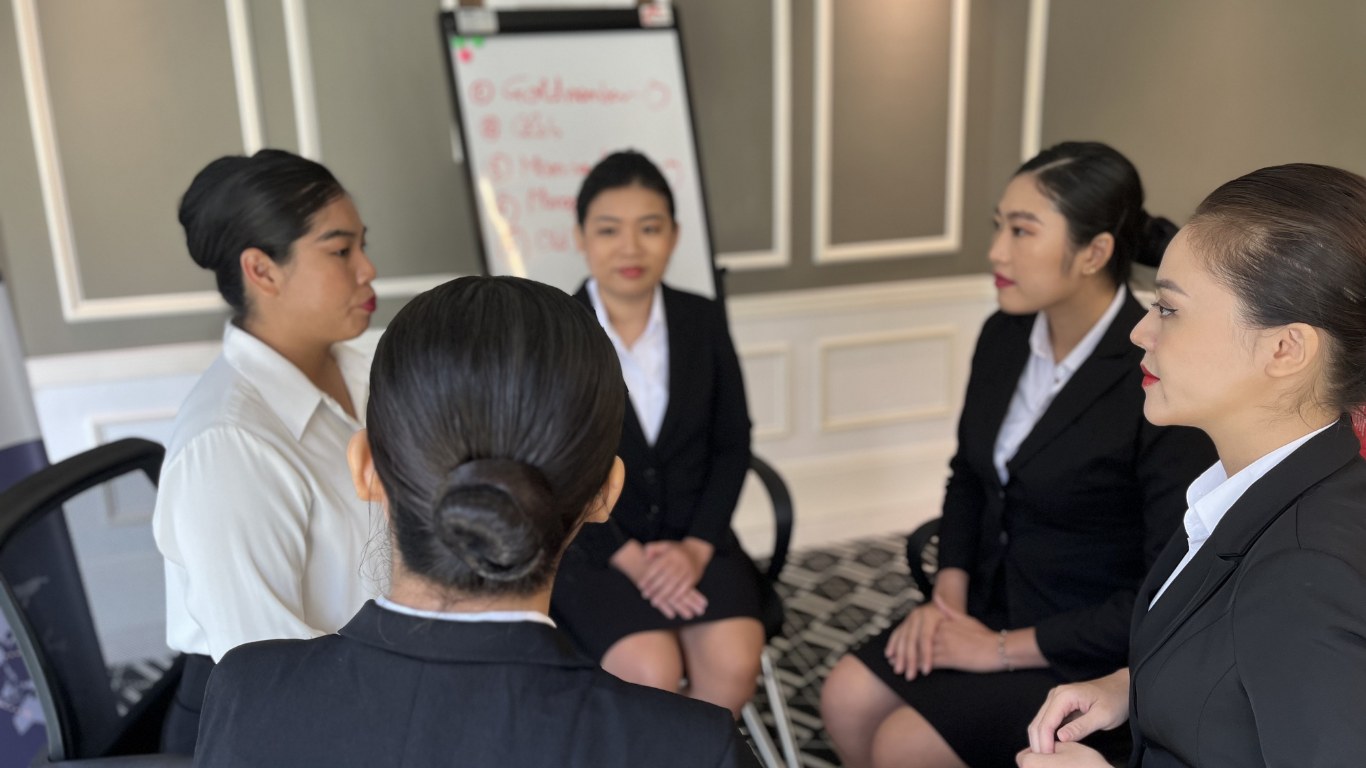
This isn't left to assumption. A meta-analysis by McDaniel, Morgeson, Finnegan, Campion, and Braverman (2001), published in the Journal of Applied Psychology, found that situational judgment questions like this one are genuinely predictive of real workplace performance — which is why airlines continue building entire rounds around them.
English / Language Assessment
Etihad also includes a separate English assessment. This is not simply a grammar test. Candidates are assessed through practical aviation and customer-service situations — describing a cabin scenario from a photograph, or choosing the correct passenger announcement.
A sentence such as:
"As soon as the aircraft arrives at the gate, you may switch on your mobile phones."
is correct. A version using "will arrive" or "is arriving" instead reads slightly off, even to a confident, fluent speaker.
The purpose of this assessment isn't impressive vocabulary. It's determining whether your English is precise enough to be understood clearly, the first time, in a real operational environment — where there's often no time for a second, clearer version of the sentence.
It's whether you can be understood clearly, the first time.

Competency / Behavioural Questions
Etihad describes its final interview as a conversation exploring your experience, motivation, and genuine interest in the role. It often begins with a broad question such as:
"How do you handle stress during long or challenging flights?"
Many candidates answer generally and stop. That is usually where they lose the opportunity. The interviewer is often leading towards a competency question — for example:
"Tell me about a time you dealt with a difficult customer."
This follows the familiar STAR structure: Situation, Task, Action, Result.
Research Note
Schmidt and Hunter's 1998 meta-analysis, covering 85 years of hiring research and published in Psychological Bulletin, found that structured interviews like this one are nearly twice as predictive of job performance as unstructured conversation — because they let recruiters observe judgement through a real example, not a hypothetical opinion.
Why Airlines Structure Interviews This Way
This approach isn't unique to aviation. SHRM's 2026 Talent Trends Report, based on a global survey of over 2,000 HR professionals, points to the same shift across industries — away from instinct and credentials, toward structured assessments that evaluate observable behaviour.
Emirates' own press releases confirm the scale this creates: a cabin crew team drawn from over 160 nationalities, recruited across hundreds of cities each year. At that scale, a structured interview isn't bureaucracy — it's the only fair, reliable way to evaluate every candidate consistently.
The Part Most Candidates Miss
Understanding each interview stage is the first step. Knowing what recruiters are actually trying to learn from each stage is what changes performance.
Most candidates prepare for the question. Far fewer prepare for what the recruiter is trying to discover.
I once coached a candidate who answered every competency question correctly. She had the right structure, the right example, the right STAR format — technically, everything was there. But she delivered every answer exactly the same way: fast, polished, heavily rehearsed. She believed good performance meant giving the correct content. The recruiter heard something different — a memorised script, not a real person recalling a genuine experience.
Her definition of what "good" looked like was.
This is the exact gap I built Global Citizens Skills™ to help candidates close — not more polish, but a clearer read of what each stage is actually asking for.
Summary
| Interview Stage | Most candidates think... | Recruiters are actually assessing... |
|---|---|---|
| Self-introduction | Introduce yourself | Can I picture working with this person? |
| Group exercise | Find the right answer | How do you work with other people? |
| English assessment | Grammar and vocabulary | Can we trust your communication in real operations? |
| Competency interview | Tell a good story | How do you make decisions through real experience? |
Sources
Etihad Airways. (2026). Cabin Crew Careers. careers.etihad.com.
Emirates. (2024). Emirates to recruit 5,000 cabin crew in 2024. emirates.com/media-centre.
Schmidt, F. L., & Hunter, J. E. (1998). The validity and utility of selection methods in personnel psychology. Psychological Bulletin, 124(2), 262–274.
McDaniel, M. A., Morgeson, F. P., Finnegan, E. B., Campion, M. A., & Braverman, E. P. (2001). Use of situational judgment tests to predict job performance: A clarification of the literature. Journal of Applied Psychology, 86(4), 730–740.
Society for Human Resource Management. (2026). 2026 Talent Trends Report.